

Modern data protection is undergoing a fundamental transformation. At Commvault SHIFT 2025, the company shares the clear message that backup alone is no longer sufficient: organizations must adopt recovery-first, cyber-validated architectures capable of restoring clean, trusted data at speed.
Among the innovations presented at the event, Synthetic Recovery stands out as one of the most strategic, enabling rapid, storage-side reconstruction of recovery-ready datasets. It also plays a central role in Commvault’s emerging Resilience Operations model (ResOps), which unifies cyber-validation, automation, and AI into a single operational discipline for cyber-resilient recovery. Let’s see in depth
What Synthetic Recovery Is and Why It Matters
Synthetic Recovery is Commvault’s technique for reconstructing a full, ready-to-recover dataset without performing a traditional full restore. Instead of rehydrating terabytes of data back into production, Commvault builds this recovery image directly on backup storage, merging incremental backups with an existing synthetic full.
This approach has several major advantages:
- Near-instant recovery readiness: heavy data consolidation happens before a disaster, not during it.
- No production impact: synthetic consolidation and recovery assembly occur on secondary storage, preserving production I/O and compute.
- Cyber-validated restore points: integrated threat scanning and cleanroom automation ensure only clean, trusted data is used for recovery.
- Massive scalability: Ideal for large VM farms, high-volume databases, and hybrid cloud environments.
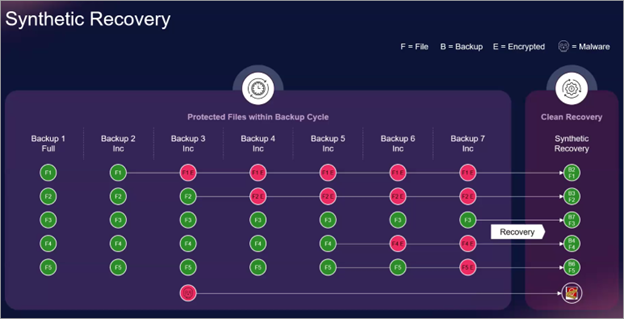
More technically, Commvault starts with a typical data ingestion workflow consisting of an initial full backup followed by forever incremental backups (optionally leveraging Change Block Tracking – CBT for virtual machines and deduplication for storage efficiency).
Instead of running periodic full backups, Commvault uses the initial full as a baseline and continuously merges incremental data into a new synthetic full created directly on backup storage.
During a recovery, Commvault simply reads the synthetic full and reconstructs a ready-to-recover image, applying any necessary overlays from the most recent incremental backups or log data.
Maintaining this always-ready recovery copy enables Commvault to analyze every backup set for anomalies (using AI-driven detection) and identify potential threats. This validation pipeline supports the creation of cleanrooms for isolated, safe recovery.
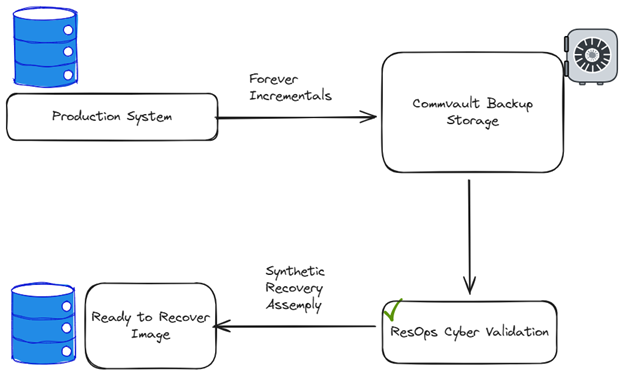
Synthetic Recovery is therefore not just a performance optimization — it is an enabler of automated, trustworthy, and repeatable cyber-resilience operations, precisely aligned with what ResOps aims to deliver.
How Synthetic Recovery Integrates into the ResOps Vision
ResOps (Resilience Operations) is Commvault’s architecture and operational model for unified, AI-driven cyber-resilience.
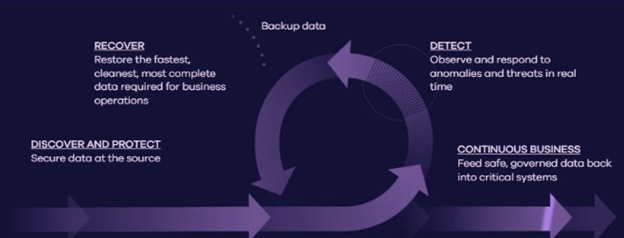
Synthetic Recovery is one of its foundational mechanisms because it:
- Provides pre-assembled images enabling fast, automated workflows (Orchestrated Recovery)
- Ensures only clean, threat-scanned datasets are restored (Cyber-Validation)
- Works with AI anomaly detection to validate backup integrity (AI-assisted Operations)
- Minimizes data movement for multi-cloud/hybrid recoveries (Cross-cloud Flexibility)
- Guarantees that restores come from validated, verified data sources (Zero-Trust Recovery)
Synthetic Recovery in Real-World Operations
The real value of Commvault’s Synthetic Recovery, and the broader ResOps approach unveiled at SHIFT 2025, lies in how effectively it supports the operational realities we face every day.
The current threat landscape demands reaction speed. When something goes wrong, whether it’s corruption, ransomware, or cloud misconfiguration, the difference between a two-hour recovery and a two-day recovery can determine whether a business stays online or grinds to a halt. Synthetic Recovery changes this dynamic by shifting the heavy work before the incident even happens.
Synthetic operations also eliminate production impact by performing consolidation, validation, and malware analysis entirely on the backup infrastructure instead of production systems. This ability to strengthen resilience without affecting performance makes Commvault a true silent data protection hero.
Finally, cloud-native ecosystems demand agility, automation, and security-by-design. Here, Commvault’s strategy aligns perfectly with modern DevSecOps practices: offering APIs to integrate recovery into automated workflows, applying cyber-validation as a security gate, enabling immutable recovery points for zero-trust architectures, and protecting container platforms and cloud workloads.
In a world where everything moves fast, and threats move even faster, Commvault’s Synthetic Recovery and ResOps vision provide the operational backbone needed to restore confidently, cleanly, and without disruption.
[…] a deeper look at Synthetic Recovery and the ResOps model (https://blog.linoproject.net/commvault-synthetic-recovery-a-core-pillar-of-resops-vision/), and my coverage of cloud-native recovery discussed during AWS re: Invent […]