
The last few weeks have offered several opportunities to look at how the cybersecurity, data protection, and infrastructure landscape is evolving. From Nashville with Commvault SHIFT 2026 and last week with SHIFT Virtual, one concept has consistently emerged from the discussions, announcements, and presentations: recovery is no longer simply about restoring data. It is about restoring trust, operations, and business capability, especially in the AI era.
The growing adoption of AI across enterprise environments is accelerating this transformation. AI is becoming deeply embedded in business operations, driving workflows, consuming enterprise data, interacting with applications, and increasingly executing tasks autonomously. This evolution creates significant opportunities while introducing new layers of complexity, highlighting the limitations of traditional data protection and recovery approaches, which may restore data without ensuring its consistency and integrity across interconnected systems.
Similarly, AI, while acting as a powerful business accelerator, introduces potential risks that require particular attention from cybersecurity teams: how do we define the guardrails for what AI can do with the company’s data? And how do we prevent and recover from AI damage? Are we really trusting in AI agents, or should we audit them like human operators?
AI agents introduce a new recovery challenge
One of the announcements that particularly caught my attention during SHIFT was AgentRecover (early access in November for Microsoft Foundry and December for Amazon Bedrock). As organizations deploy AI agents, these systems increasingly gain access to enterprise resources and the ability to interact with applications, data, and workflows. Even if Agent actions may be useful and highly productive, they introduce a new operational risk.
What happens when an AI agent performs an incorrect action? What if it modifies data, changes configurations, triggers workflows, or interacts with interconnected systems in ways that were not intended?
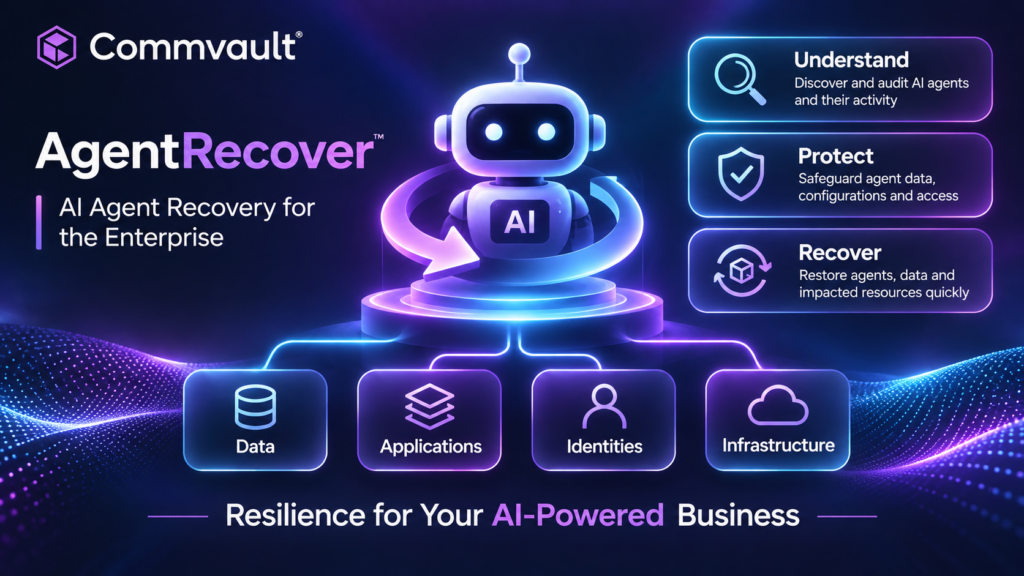
The challenge is not necessarily limited to recovering the AI agent itself. The real problem may involve understanding its activity, identifying the consequences, and recovering the resources affected by those actions. AgentRecover addresses this emerging scenario by introducing capabilities designed to help organizations audit AI agents, understand their activity, and recover agents and the resources affected by unwanted changes.
This is an important step in a conversation that I believe will become increasingly relevant as agentic AI adoption grows.
We are moving toward environments where the potential impact of an action is no longer limited to a single application or user. An autonomous agent may operate across multiple systems, potentially creating a chain of consequences that must be understood and reversed.
Essentially: AI governance and AI security will increasingly need to include AI recovery!
This conversation is no longer limited to how organizations deploy AI models or agents. Enterprise AI depends heavily on the availability of relevant, accurate, governed, and secure data.
Commvault’s announcements around Data Activate, including its collaboration with Databricks and NVIDIA, reflect this direction: enabling enterprise data to become more useful for analytics, AI applications, and agents while maintaining governance and security posture.
This is an important distinction: making data available to AI is not enough. Organizations must also understand where data comes from, whether it is trustworthy, how it is governed, and how it can be protected throughout its lifecycle.
Recovery Studio: restoring the business, not just its components
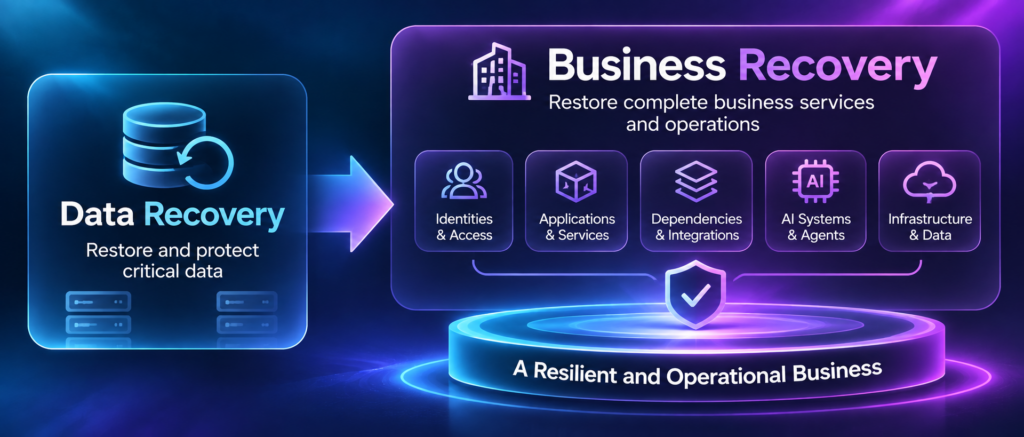
Another interesting announcement is Commvault Recovery Studio (early access from December), which extends the recovery conversation toward a more comprehensive orchestration of business services.
Modern enterprise environments are built around multiple interconnected components, where applications rely on databases, identity systems, and other underlying services. Restoring these elements independently does not necessarily guarantee the recovery of a fully functional business service.
The ability to understand dependencies, determine recovery priorities, and restore services in the correct sequence can make the difference between a technically successful recovery and an actual business recovery.
This is particularly important in complex hybrid environments, where the recovery process may involve different platforms, technologies, and operational teams.
The concept resonates strongly with the evolution of infrastructure automation and platform engineering: defining systems declaratively is only part of the equation. We also need to understand how they operate, how they depend on one another, and how to bring them back to a known-good state when something goes wrong.
Resilience is becoming broader than cybersecurity
SHIFT 2026 highlighted several areas that deserve attention beyond the traditional backup and recovery conversation:
- Identity resilience: identities and access systems are critical components of enterprise operations and must be considered in recovery strategies.
- Digital sovereignty: control over data, infrastructure, and the ability to operate or recover across different environments is becoming increasingly important.
- Hybrid complexity: organizations must deal with a growing combination of cloud, on-premises, SaaS, and cloud-native services.
- AI and data security: the adoption of AI introduces new requirements for governance, visibility, protection, and recovery.
- Future threats: organizations must begin considering emerging risks, including the long-term implications of cryptographic evolution and quantum computing.
The ResOps concept continues to be an interesting part of this evolution: that means testing recovery, validating dependencies, understanding risk, improving readiness, and ensuring that
recovery procedures are executable rather than simply documented.
The ability to recover is not measured only by the existence of backup copies. It is measured by whether an organization can successfully restore its critical services, verify their integrity, and resume operations within acceptable business expectations.
These themes underline a common concept: resilience is not a standalone technology or a product category, but it’s an organizational capability.
It requires collaboration between infrastructure, security, operations, application teams, data teams, and business stakeholders. It also requires preparation, testing, and the ability to continuously validate recovery assumptions.
For further details, check the official announcement page: https://www.commvault.com/blogs/commvault-announces-ai-recovery-for-ai-vulnerabilities-2
SHIFT Virtual and Takeaways
Last week, SHIFT 2026 Virtual event represented another opportunity to explore these topics beyond the physical event in Nashville.
The combination of keynotes, technical sessions, customer experiences, and discussions across cyber recovery, identity resilience, hybrid complexity, AI and data security, cloud-native resilience, and emerging threats provides a broader perspective on the challenges organizations are facing.
What I particularly appreciate about these conversations is the way they connect technology with operational reality.
The industry is moving beyond the simple idea of protecting infrastructure, and we are increasingly discussing how organizations can maintain confidence in their systems while adopting new technologies, automating processes, and introducing AI into their environments.
AI will accelerate innovation, automation, and operational efficiency. But greater autonomy and interconnectedness also mean that failures, security incidents, and unintended consequences can propagate faster and affect more systems.
Organizations therefore need to rethink resilience, overcoming the thought that only data protection and infrastructure availability are enough to keep their businesses healthy against today’s threats. Extending recoverability across identities, applications, dependencies, and AI systems is a fundamental step towards building a robust recovery strategy, enabling organizations to respond to disruptions with greater confidence and effectiveness. So, recovery is becoming the foundation that enables organizations to move forward, even when things go wrong.